



Europe Is Building the Physical Layer
From AI chips to rocket launchers, 6G networks to hydrogen storage, a single week of European deep tech activity reveals a deliberate pivot toward hardware sovereignty.
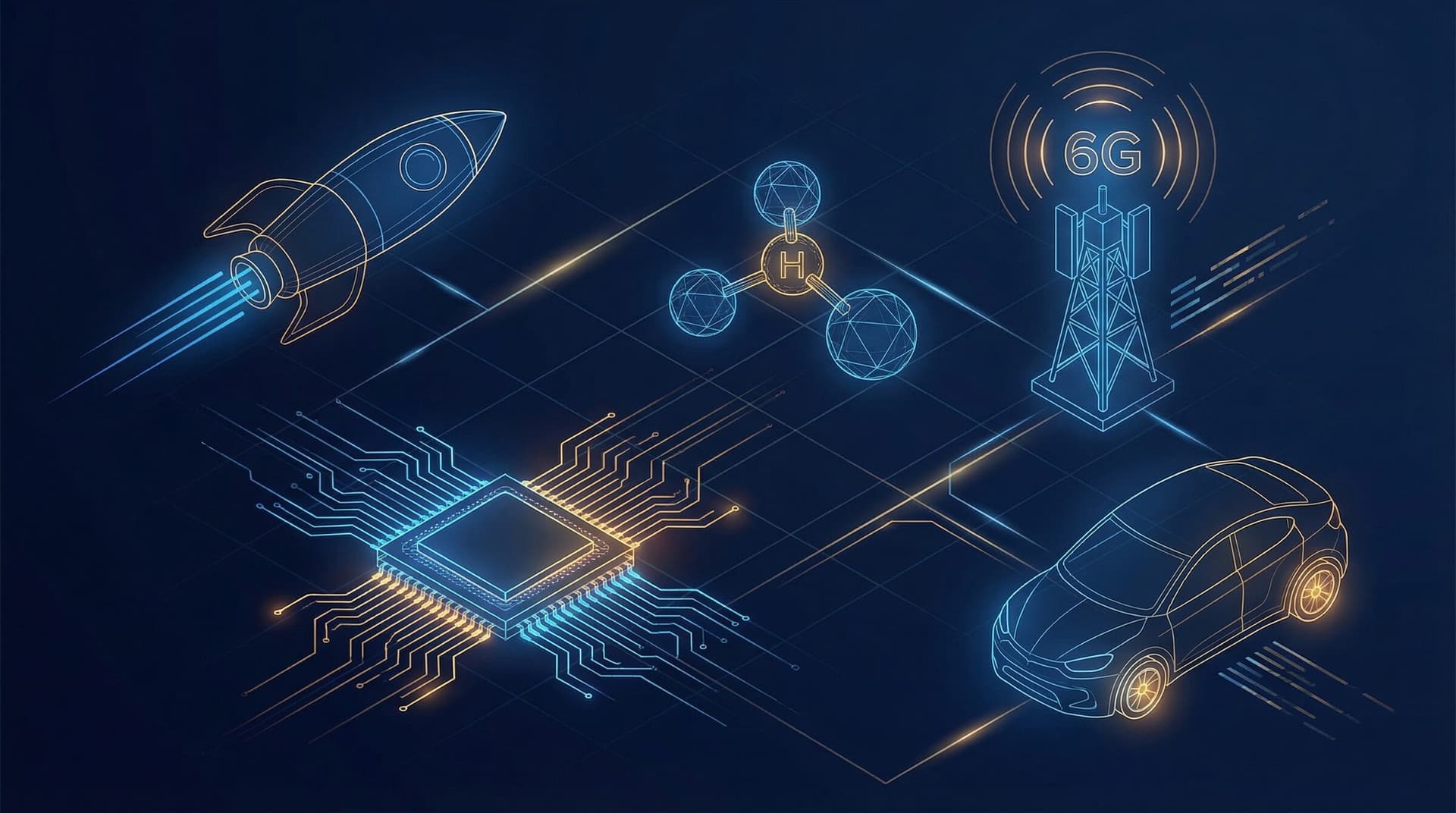

In the first two weeks of March 2026, ten separate announcements across the European deep tech landscape landed within days of each other. A new Industrial Accelerator Act from the Commission. A 116-million-euro package for 6G research. A billion-dollar seed round for physical AI. Defence commitments, space launch funding, chip memory startups, solid hydrogen storage, autonomous vehicle software, and biotech incubation. Read individually, they are deal flow. Read together, they are a strategy.
The strategy is hardware. After two decades of watching American and Chinese platforms dominate the software layer, Europe is making a concentrated bet on the physical infrastructure of the next technology cycle: the chips, the networks, the launchers, the storage systems, and the machines that will underpin whatever comes after the current generation of cloud-and-model architectures.
The Industrial Accelerator Act
On March 4, the European Commission proposed the Industrial Accelerator Act, a legislative package that introduces "Made in EU" and low-carbon requirements in public procurement and support schemes across strategic sectors including steel, cement, aluminium, automotive, and net-zero technologies [1].
The Act sets a target of increasing manufacturing's share of EU GDP from 14.3% (2024) to 20% by 2035. It also introduces a new screening threshold for non-EU investments: foreign direct investments of at least 100 million euros from companies controlling over 40% of global manufacturing capacity in strategic sectors must guarantee at least 50% employment of EU workers and demonstrate real technology and knowledge transfer [1].
This is not protectionism dressed in policy language. It is industrial policy that explicitly names the physical layer as the arena where Europe intends to compete.
The Hardware Stack
The week's funding and programme announcements map neatly onto the layers of a physical technology stack:
Chips: Vertical Compute (Belgium, EUR 37M)
Designing new memory components for AI chips in partnership with TSMC, tackling the memory bottleneck that limits current AI hardware. Series B funding to move from lab to market [7].
Networks: 6G (EU, EUR 116M)
Twenty projects funded through the SNS Joint Undertaking, spanning health, mobility, space, media, and manufacturing. Nearly 80% embed AI and machine learning. The portfolio now totals 100 projects with 98 patents registered [2].
Launch: PLD Space (Spain, EUR 180M)
Series C funding for MIURA 5, targeting more than 30 launches per year by 2030. Led by Mitsubishi Electric, with Spanish government co-investment. Spain's science minister framed it as "investing in technological sovereignty" [5].
Storage: Photoncycle (Norway, EUR 15M)
Solid-hydrogen systems that store summer solar energy for winter heating. Series A funding for residential rollout in Denmark and the Netherlands starting 2027, targeting 1.4 TWh annual capacity [9].
Defence: Join Capital (EU, EUR 50M)
The EIF's largest defence-focused commitment to date, targeting 25 early-stage startups across defence, security, space, and dual-use tech. Part of a EUR 235M fund expected to unlock over 500 million euros total [4].
Autonomy: Oxa (UK, $103M)
Oxford spinout scaling autonomous vehicle software for ports, airports, factories, and logistics sites. Series D backed by Nvidia, BP, and the UK National Wealth Fund. Customers include BP, DHL, and Vantec [8].
Physical AI as Organising Principle
The phrase "physical AI" appeared in the EIC's first Advanced Innovation Challenges call and drew 425 of the 709 total proposals submitted from 39 countries. Applicants requested 130.7 million euros in EU funding. The second challenge, on non-animal testing methodologies, attracted 284 proposals [3]. Germany led submissions (84), followed by Italy (71) and the Netherlands (62). Companies made up 69% of applicants, with higher education at 17% and research organisations at 13%.
The demand signal is clear. When the EIC offered ARPA-style lump-sum grants of 300,000 euros for physical AI projects, with the promise of up to 2.5 million euros in follow-on funding in 2027, nearly half a billion euros in requests arrived within a single call window [3].
AMI Labs, the Paris-linked startup founded with Yann LeCun as executive chair, landed a 1-billion-dollar seed round to build "world models" that understand the physical world rather than generating text or images. Backed by Nvidia, Temasek, Bezos Expeditions, and others, AMI is targeting robotics, manufacturing, and wearables [6]. It is the largest seed round in European history, and its thesis is that the next generation of AI will be measured not by what it writes, but by what it can do in the physical world.
Europe lost the platform wars. It is not planning to lose the infrastructure ones.
The Capital Picture
| Company / Programme | Amount | Layer | Ref |
|---|---|---|---|
| AMI Labs | $1B | Physical AI / world models | [6] |
| PLD Space | EUR 180M | Launch infrastructure | [5] |
| 6G SNS JU | EUR 116M | Next-gen networks | [2] |
| Oxa | $103M | Industrial autonomy | [8] |
| EIF / Join Capital | EUR 50M | Defence / dual-use | [4] |
| Vertical Compute | EUR 37M | AI chip memory | [7] |
| Photoncycle | EUR 15M | Solid hydrogen storage | [9] |
| BioInnovation Institute | EUR 1.3M | Biotech / quantum diagnostics | [10] |
Total capital mobilised in this window alone exceeds 1.5 billion euros in direct commitments, with the EIF's defence facility expected to unlock another 500 million [4]. The Industrial Accelerator Act, if adopted, would reshape procurement rules across the EU's entire manufacturing base [1].
What This Means
Three things stand out.
First, the public and private signals are aligned. The Commission's Industrial Accelerator Act, the EIC's physical AI challenge, and the EIF's defence commitment all point the same direction as the private capital flowing into PLD Space, AMI Labs, Vertical Compute, Oxa, and Photoncycle. This degree of alignment between policy instruments and venture capital is unusual for Europe.
Second, the geographic spread is wide. The ten items span Spain (PLD Space), France (AMI Labs), Belgium (Vertical Compute), Norway (Photoncycle), the UK (Oxa), Denmark (BioInnovation Institute), and Germany (Join Capital), plus 39 countries in the EIC applicant pool [3]. This is not a story about one hub. It is a continent-scale pattern.
Third, the definition of "deep tech" has narrowed. The projects that attracted the most capital in this window are not platform plays or consumer apps. They are chip architectures, launch vehicles, energy storage chemistry, autonomous systems, and next-generation network infrastructure. The common denominator is that they involve hard engineering problems with long development timelines and physical outputs. Europe appears to have concluded that this is where its comparative advantage lies.
Looking Ahead
The EIC Advanced Innovation Challenges will announce results by May 2026, with up to 2.5 million euros in follow-on grants available in 2027 for the most promising projects [3]. PLD Space's MIURA 5 is scheduled for its first test flight in 2026 [5]. Photoncycle plans its first residential rollouts in 2027 [9]. The Industrial Accelerator Act now goes to the European Parliament and Council for adoption [1].
Whether this hardware bet pays off will depend on execution, and as our previous analysis of Europe's delivery gap showed, execution remains the hard part. But the direction is now unambiguous. Europe is building the physical layer.
References
[1] European Commission, "Commission proposes new measures to boost EU industry and jobs," Press Release, Mar. 4, 2026. [Online]. Available: https://commission.europa.eu/news-and-media/news/commission-proposes-new-measures-boost-eu-industry-and-jobs-2026-03-04_en
[2] European Commission, "Europe to advance 6G innovation: 20 projects set to receive EU116 million," Digital Strategy, Mar. 2026. [Online]. Available: https://digital-strategy.ec.europa.eu/en/news/europe-advance-6g-innovation-20-projects-set-receive-eu116-million
[3] European Innovation Council, "High interest in first EIC Advanced Innovation Challenges call," EIC News, Mar. 9, 2026. [Online]. Available: https://eic.ec.europa.eu/news/high-interest-first-eic-advanced-innovation-challenges-call-2026-03-09_en
[4] European Commission, "InvestEU Defence Equity Facility: European Investment Fund commits EU50 million to Join Capital Fund III," Defence, Industry and Space, Mar. 4, 2026. [Online]. Available: https://defence-industry-space.ec.europa.eu/investeu-defence-equity-facility-eif-commits-eu50-million-join-capital
[5] Tech.eu, "Spain's PLD Space raises EUR180M to scale satellite launch infrastructure," Mar. 4, 2026. [Online]. Available: https://tech.eu/2026/03/04/spains-pld-space-raises-eur180m-to-scale-satellite-launch-infrastructure/
[6] Sifted, "Yann LeCun's AMI Labs raises $1B," Mar. 2026. [Online]. Available: https://sifted.eu/articles/yann-lecun-ami-labs-meta-funding-round-nvidia
[7] Sifted, "Vertical Compute raises EUR37M for AI chip memory tech," Mar. 2026. [Online]. Available: https://sifted.eu/articles/vertical-compute-ai-chips-memory-37m
[8] Sifted, "Oxa raises $103M for industrial autonomy," Mar. 2026. [Online]. Available: https://sifted.eu/articles/oxa-raises-103m-nvidia-bp/
[9] Sifted, "Solid hydrogen startup Photoncycle raises EUR15M," Mar. 2026. [Online]. Available: https://sifted.eu/articles/solid-hydrogen-startup-photoncycle-raises-e15m/
[10] Tech.eu, "BioInnovation Institute backs five startups with EUR1.3M in follow-on funding," Mar. 3, 2026. [Online]. Available: https://tech.eu/2026/03/03/bioinnovation-institute-backs-five-startups-with-eur13m-in-follow-on-funding/
Pulse News Team
ResearchArk