



Europe's Innovation Paradox: Record Budgets, Broken Pipelines
In a single week, the EU committed billions to deep tech, delayed its own AI rules, and was told by its own auditors that its flagship innovation fund has barely disbursed. What is going wrong?
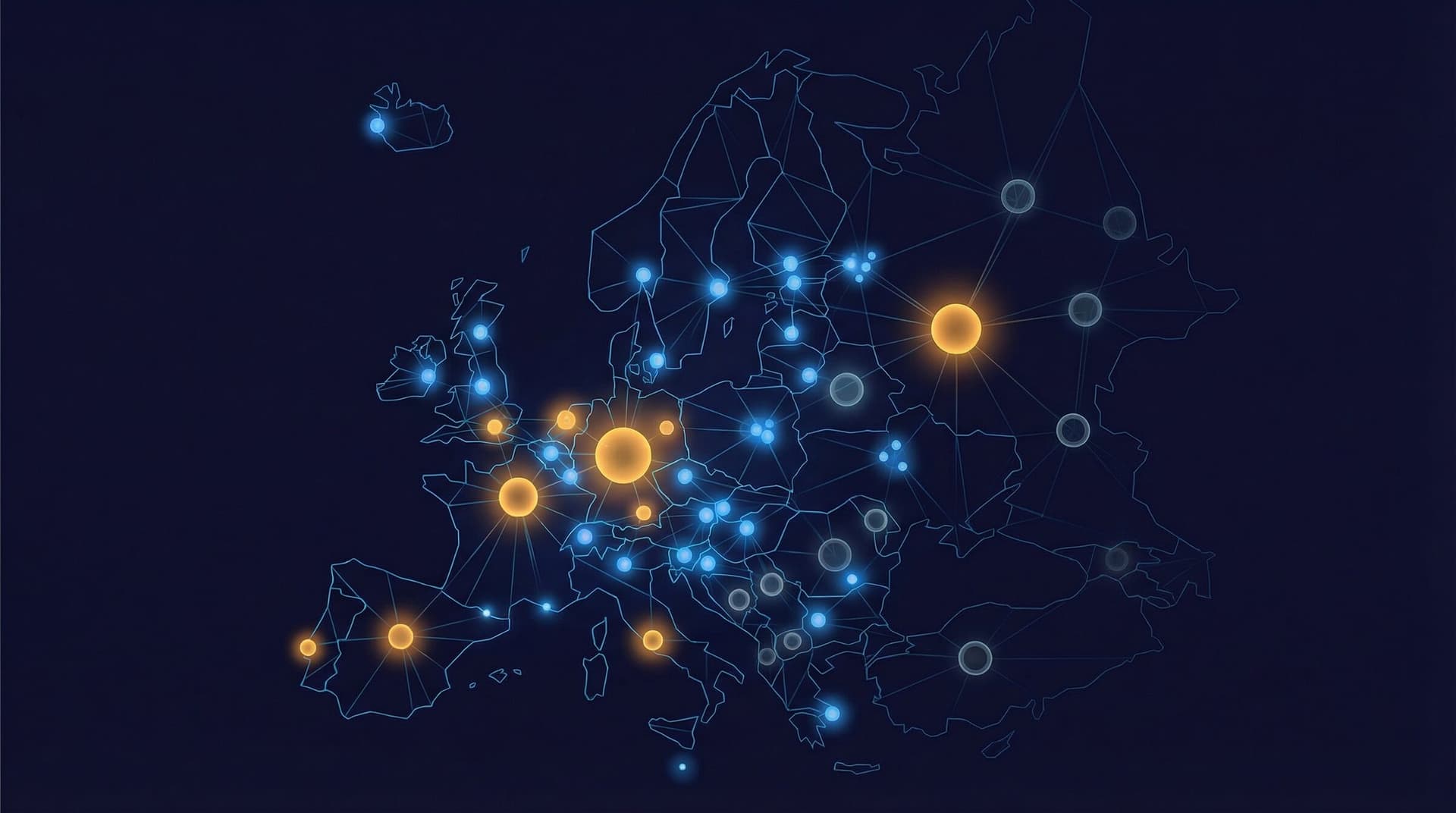

In the third week of March 2026, Europe did something revealing. It wrapped up a major deep tech gathering in Paris, a Munich-based startup announced a 2-billion-euro fusion test facility in Germany, and a fresh Horizon Europe call opened nearly 91 million euros for space research. In the same week, the EU Court of Auditors published a report finding that the Innovation Fund, with a projected 40-billion-euro envelope, had reached fewer than one percent of its project targets after five years of operation [1]. The EU Council, meanwhile, adopted a negotiating position proposing to push back the deadline for high-risk AI rules by up to sixteen months [2].
That is not a contradiction. It is a pattern. And it tells us something important about where European research and innovation policy stands right now.
The Scale of Ambition
The numbers are not the problem. Europe's headline commitment to research, technology, and innovation in 2026 is genuinely large. The Horizon Europe work programme for 2026 to 2027 allocates 14 billion euros across its clusters, including 1.25 billion for Marie Sklodowska-Curie Actions alone and a new 50-million-euro "Choose Europe for Science" initiative to attract global talent [3]. The European Innovation Council's 2026 programme commits 1.4 billion euros, introducing ARPA-style "Advanced Innovation Challenges" alongside a streamlined EIC Accelerator that has cut full proposals from 50 pages to 20 and moved to two-month evaluation cycles [4]. A new Horizon Europe call under Cluster 4 (Digital, Industry and Space) opens 90.97 million euros for EU space research [5].
On the private side, Proxima Fusion, a Munich-based stellarator startup founded by alumni of the Max Planck Institute, MIT, and Google X, announced "Project Alpha," a 2-billion-euro fusion test facility in Germany [6]. The European Deeptech Week in Paris drew over 70 speakers to discuss AI, cybersecurity, defence tech, climate solutions, and life sciences, reflecting what organizers described as Europe's ambition to become the global centre of gravity for deep tech [7].
By any measure, the money is on the table.
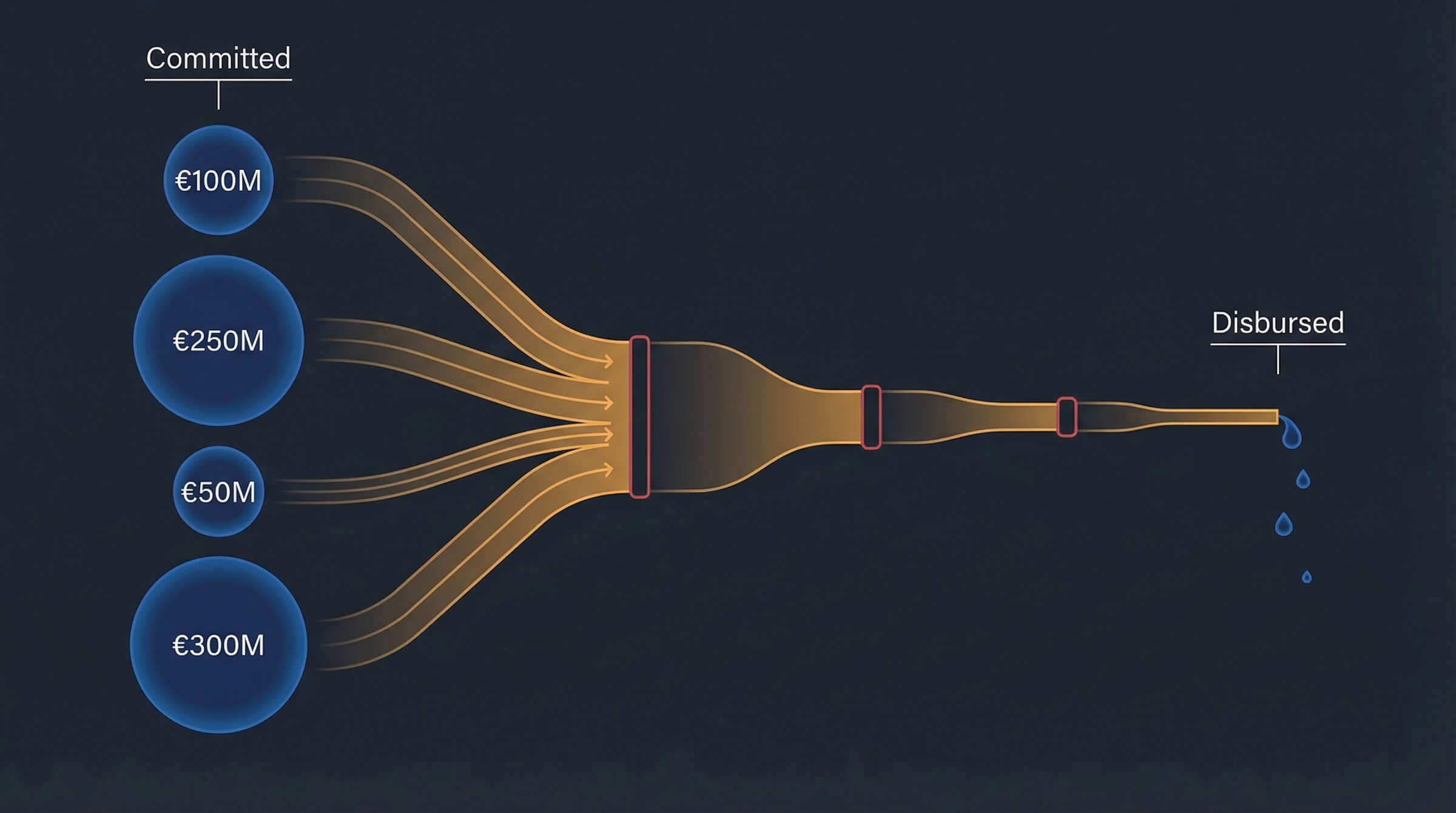
The delivery gap: Europe's innovation funding pipeline narrows sharply between commitment and disbursement.
The Delivery Gap
The Court of Auditors' Special Report 11/2026 is the sharpest single data point. After five years, the Innovation Fund, funded by EU Emissions Trading System revenues with a projected envelope of 40 billion euros, had reached fewer than one percent of its project targets. The auditors attributed this to political priority-setting without structured forward-looking analysis, an observation that applies well beyond a single fund [1].
This is not an isolated finding. It sits within a broader institutional pattern where commitment outpaces execution:
Regulatory Delay
The EU Council's March 13 negotiating position on the "Digital Omnibus on AI" proposes extending high-risk AI compliance deadlines by up to sixteen months beyond the original August 2026 date [2]. The AI-generated content Code of Practice under Article 50 of the AI Act, with its final version expected in June 2026, illustrates how even secondary instruments add months to enforcement timelines [8].
Structural Fragmentation
The European Innovation Act, expected in Q1 2026, must introduce a new "28th regime" company status, EU-wide regulatory sandboxes, and streamlined tech transfer rules because 27 separate regulatory realities still prevent startups from scaling across borders [9].
Strategic Drift
LERU warns against "excessive securitisation" and over-instrumentalisation of research, noting that the MFF 2028-2034 negotiations will determine "whether Europe is serious about its ambition to remain a global scientific leader" [10].
External Pressure
The launch of EU-India Horizon Europe association talks following the February 2026 summit reflects a growing need to internationalise the programme, even as its domestic delivery mechanisms remain strained [11].
Reading the Week as a System
If you read these ten developments as isolated events, they look like good news with a few footnotes. If you read them as a system, the picture is different.
Europe has built two machines that operate at different speeds. The commitment machine, composed of political leadership, framework programmes, and industrial strategy documents, moves fast. It can announce billions, open calls, and host summits with impressive cadence. The delivery machine, composed of disbursement pipelines, regulatory enforcement, cross-border legal harmonisation, and evaluation infrastructure, moves slowly. It is often still processing the previous generation of commitments when the next one arrives.
The EIC's shift to ARPA-style challenges and two-month evaluation cycles [4] is a direct acknowledgment of this problem. So is the Innovation Act's proposed 28th regime [9]. These are not incremental improvements. They are structural admissions that the existing machinery is too slow for the technologies it is supposed to support.
Innovation Fund established
ETS revenues backing clean-tech deployment
Horizon Europe launched
EUR 95.5B framework programme
AI Act adopted
Parliament & Council approve landmark regulation
Horizon Europe 2026-27 work programme
EUR 14B across clusters + talent initiatives
EIC 2026 programme
EUR 1.4B + ARPA-style challenges + Innovation Act + EU-India talks
Innovation Fund: <1% of targets
Court of Auditors finds near-total disbursement failure
AI Act: 16-month extension proposed
High-risk compliance deadlines pushed back
28th regime needed
27 regulatory realities block cross-border scaling
MFF 2028-2034 negotiations begin
FP10 decision point — will delivery match ambition?
What the Data Tells Us
Consider the funding landscape as it stands in March 2026. The table below summarises the major instruments and their current status:
| Instrument | Budget | Status | Source |
|---|---|---|---|
| Innovation Fund | EUR 40B (projected) | Less than 1% disbursed | [1] |
| Horizon Europe 2026-27 | EUR 14B | Calls open | [3] |
| EIC 2026 | EUR 1.4B | ARPA-style reform underway | [4] |
| Space Research Call | EUR 90.97M | Open | [5] |
| Proxima Fusion (private) | EUR 2B | Facility announced | [6] |
| AI Act (high-risk rules) | Regulatory | 16-month extension proposed | [2] |
The pattern is legible. Public instruments with large envelopes and long disbursement chains are underperforming. Newer instruments with reformed processes (EIC) are attempting to close the gap. Private capital (Proxima Fusion, Peeriot in Leipzig [12]) is moving faster because it operates outside the institutional pipeline entirely.
The Paradox Is Not New, But the Stakes Are
Europe's "innovation paradox," strong in research, weak in commercialisation, has been documented for decades. What makes the 2026 iteration different is the convergence of three pressures:
First, the technology cycle is accelerating. Deep tech, AI, fusion, space, and industrial IoT do not wait for 16-month regulatory extensions. Every month of delay in the AI Act is a month where European companies operate without the legal clarity that a finalised enforcement framework would provide.
Second, the fiscal window is closing. The current Multiannual Financial Framework runs through 2027. Negotiations for the 2028-2034 MFF, which will determine the budget for FP10 (the successor to Horizon Europe), are about to begin. As LERU has argued, these negotiations will "define European research and innovation policy for the decade to come" [10]. If the delivery record of existing instruments is poor, the political case for increasing the next framework's budget weakens.
Third, the geopolitical context has shifted. The launch of EU-India Horizon Europe association talks [11] reflects a broadening of the programme's international scope. But association agreements add complexity to an already strained administrative apparatus. More partners means more coordination, more reporting, and more opportunities for disbursement bottlenecks.
Europe does not have a funding problem. It has a delivery architecture that was designed for a slower era of science and technology.
What Would Closing the Gap Require?
The reforms already underway offer clues. The EIC's shift to two-month evaluation cycles and 20-page proposals [4] is a direct attack on the evaluation bottleneck. The Innovation Act's 28th regime [9] attempts to bypass the fragmentation problem rather than solve it at the member-state level. Both approaches share a logic: if you cannot fix the existing system, build a parallel one.
Whether that logic scales is the open question. A parallel company registration regime is useful for a few hundred startups. It does not address the structural reasons why 27 regulatory realities exist in the first place. Faster evaluation cycles help, but they do not fix the disbursement pipeline that sits downstream of evaluation.
The auditors' observation about "political priority-setting without structured forward-looking analysis" [1] points to something deeper. Europe's innovation policy is good at creating new instruments and bad at operating them at steady state. Each political cycle produces new programmes, new calls, and new labels. The operational layer, procurement, legal review, financial control, reporting, that actually moves money from Brussels to laboratories and startups, receives less attention and fewer resources.
Looking Ahead
The week of March 16 to 20, 2026, was not a crisis. It was a diagnostic. The ambition is real. The capital is available. The private sector is moving. The question is whether Europe's institutional infrastructure can match the pace of the technologies and companies it is trying to support.
For researchers, research managers, and funders tracking this space: the signals are mixed but actionable. The EIC Accelerator's next submission window is approaching [4]. The Horizon Europe space call is open [5]. The Innovation Act will reshape cross-border scaling rules once it lands [9]. The delivery gap is real, but so are the opportunities for those who know where to look.
References
[1] European Court of Auditors, "Special Report 11/2026: The Innovation Fund," European Court of Auditors, Luxembourg, Mar. 19, 2026. [Online]. Available: https://www.eca.europa.eu/en/publications/sr-2026-11. Reported by Startuprad.io. [Online]. Available: https://www.startuprad.io/post/eu-innovation-fund-2026-audit-european-deep-tech
[2] Council of the European Union, "Council agrees position to streamline rules on artificial intelligence," Press Release, Mar. 13, 2026. [Online]. Available: https://www.consilium.europa.eu/en/press/press-releases/2026/03/13/
[3] European Research Executive Agency, "Horizon Europe 2026-27: EU14 billion for better research careers, greener, stronger EU," REA News, Dec. 12, 2025. [Online]. Available: https://rea.ec.europa.eu/news/horizon-europe-2026-27
[4] European Innovation Council, "EIC 2026 Work Programme," European Commission, 2026. [Online]. Available: https://eic.ec.europa.eu/eic-2026-work-programme_en
[5] Open Access Government, "Horizon Europe opens EUR 90.97 million EU space research call for 2026," Mar. 12, 2026. [Online]. Available: https://www.openaccessgovernment.org/horizon-europe-opens-e90-97-million-eu-space-research-call-for-2026/206309/
[6] Deep Tech Europe News, "DeepTech in Europe News, March 2026," blog.mean.ceo, Mar. 2026. [Online]. Available: https://blog.mean.ceo/deeptech-europe-news-march-2026/
[7] EU-Startups, "The European Deeptech Week 2026: Startups, speakers and key moments shaping the week," Mar. 2026. [Online]. Available: https://www.eu-startups.com/2026/03/the-european-deeptech-week-2026
[8] European Commission, "Commission publishes first draft Code of Practice on marking and labelling AI-generated content," Digital Strategy, Dec. 17, 2025. [Online]. Available: https://digital-strategy.ec.europa.eu/en/news/commission-publishes-first-draft-code-practice
[9] Taylor Wessing, "The European Innovation Act," Insights, Jan. 2026. [Online]. Available: https://www.taylorwessing.com/en/insights-and-events/insights/2026/01/the-european-innovation-act
[10] League of European Research Universities, "European research and innovation faces a pivotal year in 2026," LERU News, 2026. [Online]. Available: https://www.leru.org/news/european-research-and-innovation-faces-a-pivotal-year-in-2026
[11] Horizon Europe NCP Portal, "EU-India Horizon Europe Association Talks," NCP Portal News, 2026. [Online]. Available: https://horizoneuropencpportal.eu/news
[12] OpenPR, "Peeriot closes seven-figure late-seed funding for product," OpenPR News, Mar. 19, 2026. [Online]. Available: https://www.openpr.com/news/4431824/peeriot-closes-seven-figure-late-seed-funding-for-product
Pulse News Team
ResearchArk