



Europe's Compute-Intelligence Frontier: From Atom Lithography to Sovereign AI
From atom-beam lithography in Bergen to a 54-qubit computer in Munich and a mandate to train Europe's own frontier AI model, the fortnight of March 18–28 reveals the architecture of Europe's sovereign compute stack.
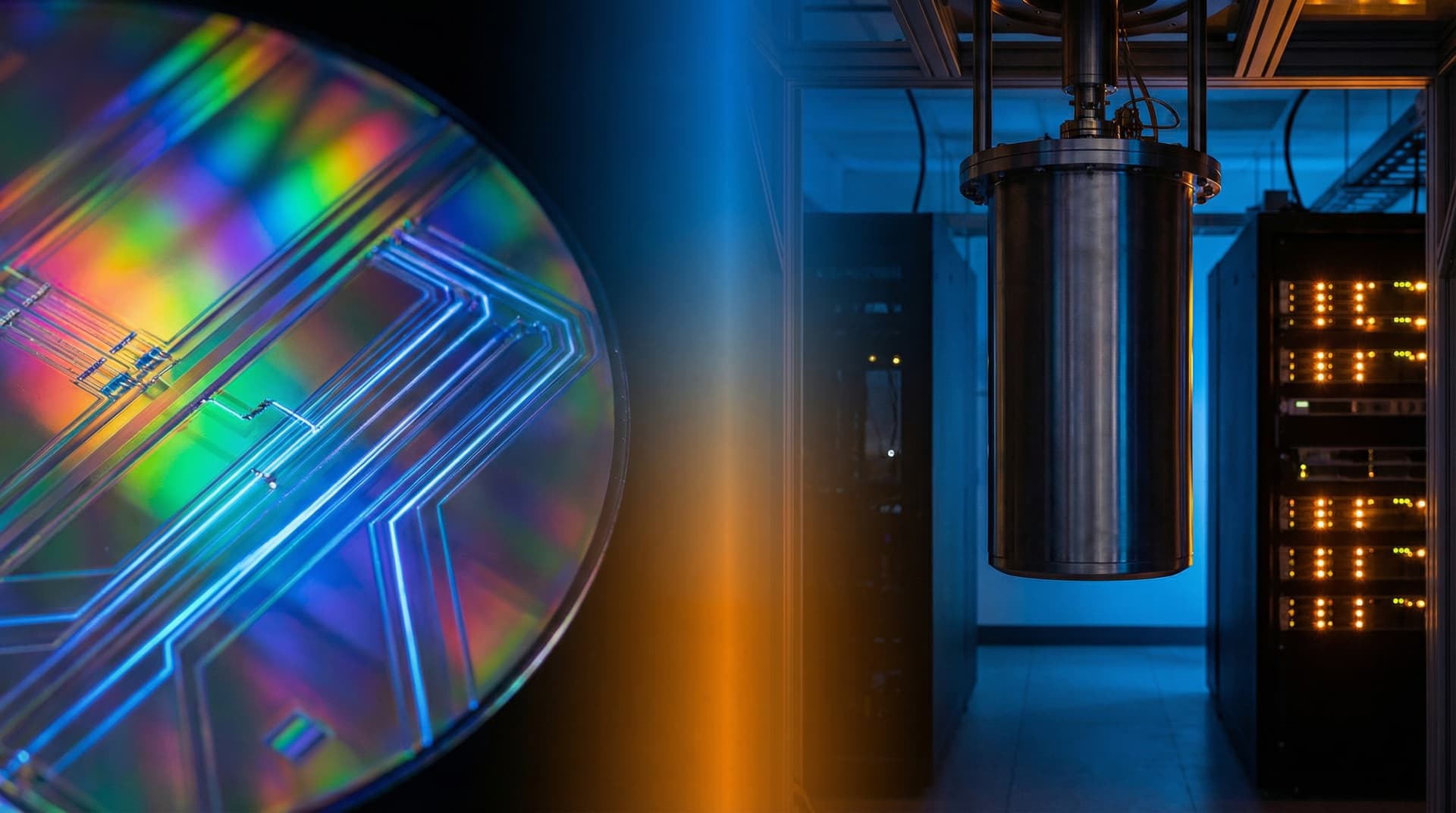

A single fortnight in March 2026 produced a set of announcements that, read together, sketch the architecture of a compute-intelligence stack Europe is building from its deepest physical layer upward. A Norwegian startup replaced photons with atoms to pattern chips at sub-nanometre scale. A 54-qubit quantum computer was inaugurated at a supercomputing centre in Munich, with a roadmap to 150. CERN and ETH Zurich published methods for compiling neural networks directly into the silicon of particle detectors. And the European Commission formalised a mandate to train the continent's first sovereign frontier AI model. None of these are unrelated. They are the same bet, placed at different layers of the same stack.
The previous three articles in this series traced European ambition at the level of commitments — budgets announced, laws passed, strategies published. This article takes stock of a fortnight in which several layers of that ambition began to acquire physical form: laboratories producing results, hardware entering operation, and capital finding its way through institutions into company accounts. The delivery gap documented in article three has not closed, but in compute and intelligence infrastructure specifically, the gap between commitment and deployment has narrowed in ways that are worth examining precisely.
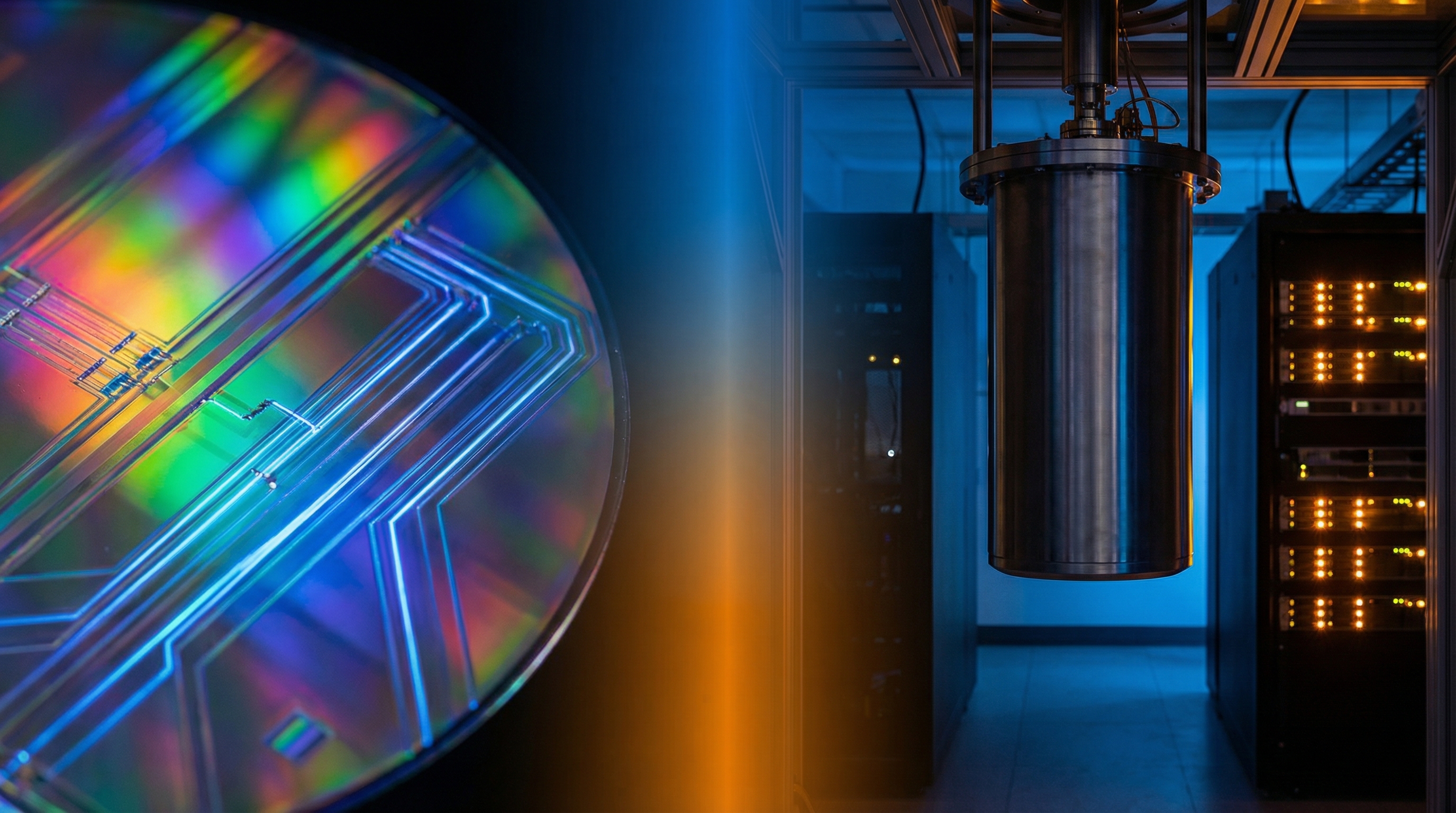
From atom-beam lithography to quantum hardware to AI-burned silicon: Europe's compute-intelligence infrastructure is taking physical shape across multiple layers simultaneously.
The Substrate Is Being Reinvented
The most foundational layer of any intelligence stack is the chip — and the most foundational constraint on the chip is the tool used to pattern it. Bergen-based Lace Lithography closed a €34.5M Series A on 26 March, led by Atomico and Microsoft's M12, bringing total funding to €51.7M [4]. The significance is not the round size. It is the physics. Conventional extreme ultraviolet (EUV) lithography uses photons — light — to expose chip patterns at the smallest scales current manufacturing can achieve. Lace is replacing photons with neutral atom beams, a technique it calls Beyond-EUV (BEUV), which achieves sub-nanometre resolution that photons cannot reach at any wavelength available to commercial tools. The company positions the technology not as an incremental improvement to existing lithography but as a shift in the patterning substrate itself.
The strategic implication is significant. Semiconductor lithography has been a monoculture: one technology (EUV), one supplier (ASML), one geography of final assembly (the Netherlands). Lace does not threaten ASML's current dominance — its technology is too early for that — but it opens a credible alternative development pathway originating in Europe, funded by European and American venture capital, and targeting the AI chip fabrication nodes that will define the next decade of compute density. The €51.7M total raised is modest relative to the capital intensity of semiconductor manufacturing, but the technical milestone justifies the attention it received.
One level up the stack, Imec announced the CMOS 2.0 initiative in March, funding 26 PhD researchers across 26 European universities with direct access to its NanoIC pilot line in Leuven [7]. The focus is next-generation semiconductor architectures beyond classical CMOS scaling, connecting academic research to the fabrication infrastructure that could bring those architectures to physical reality. The initiative addresses both the technical horizon beyond current CMOS scaling and the human capital shortage that has historically made European chip ambitions harder to staff than to fund.
Germany's IPCEI on Advanced Semiconductor Technologies, which selected 38 projects across 12 German states with total investment exceeding €3B, adds industrial manufacturing depth to the research layer, with photonic integrated circuits, advanced chips, and novel manufacturing among the priority focus areas [13]. Taken together, BEUV atom lithography, CMOS 2.0 university research, and the German IPCEI represent activity at three distinct points along the timeline from fundamental physics to manufactured component — which is precisely the kind of coverage that a serious semiconductor ecosystem requires.
Log scale used due to range from €52M to €11.4B. Defence aggregate = MYRIAD (€5M) + AGILE (€115M) + Arkadia Space (€14.5M). Sources: [4], [9], [20], [1], [5], [10], [12], [3], [13], [14].
Intelligence Burned Into Silicon
While Lace Lithography works on the tools that will pattern the chips of the 2030s, CERN and ETH Zurich have published a demonstration of what those chips — and their predecessors — are already being made to do. On 22 March, The Register reported on work by CERN and ETH Zurich using the open-source hls4ml framework to compile trained machine learning models directly into the hardware logic of FPGAs [6]. The application is the Large Hadron Collider's Level-1 trigger: the system that decides, in real time and at nanosecond latency, which of the roughly 40 million proton collision events per second are scientifically interesting enough to retain.
The physics of the problem drives the engineering constraint. The LHC generates approximately 40,000 exabytes of raw sensor data per year — a figure that makes conventional data-centre architectures irrelevant, because data cannot travel to a server and return a decision before the next collision renders it stale. The trigger must decide before any data leaves the detector. That means the neural network performing event classification must be embedded in the silicon itself, executing inference in nanoseconds.
The stakes rise sharply with the High Luminosity LHC upgrade scheduled for 2031. HL-LHC will increase the trigger data rate from the current 4 terabits per second to 63 Tb/s — a 15.75-fold increase [6]. The hls4ml work — applying post-training quantization, structured pruning, and knowledge distillation to reduce model complexity before hardware compilation — is not an academic exercise. It is preparation for an infrastructure upgrade whose requirements fall outside what any off-the-shelf AI accelerator can satisfy. The techniques being developed at CERN will inform edge AI deployment far beyond particle physics: anywhere that inference latency must be measured in nanoseconds and data volumes preclude cloud offload.
The relevance of CERN's work to Europe's broader compute-intelligence ambitions extends beyond the physics programme. The hls4ml framework is open source. The techniques for compressing large neural networks into FPGA logic blocks without prohibitive accuracy loss are directly applicable to satellite edge inference, autonomous vehicle perception, and medical diagnostic devices — any domain where inference must occur at the point of data generation, without round-trip latency to a data centre. Europe's big-science infrastructure, often critiqued as disconnected from commercial applications, is producing exportable methods for the embedded AI layer that no cloud provider can supply.
Sovereign Compute at Scale
Above the chip and the FPGA sits the compute infrastructure that trains and serves AI models. Two parallel tracks — quantum and classical — saw material progress in the fortnight covered here. On the classical side, the EuroHPC regulation was amended in January to formally mandate the establishment of AI Gigafactories: large-scale publicly accessible AI training clusters that would give European researchers and companies access to frontier-scale compute without dependence on American hyperscale providers [15]. The Frontier AI Grand Challenge, launched by the Commission in partnership with EuroHPC on 13 February, takes that infrastructure mandate one step further: it solicits a single European consortium to train a sovereign frontier AI model, targeting the frontier capability tier [16].
On the quantum side, EuroHPC JU inaugurated Euro-Q-Exa at the Leibniz Supercomputing Centre in Munich on 12 February, launching at 54 qubits with a documented roadmap to 150 [8]. The system's integration with LRZ's classical supercomputing environment creates a hybrid quantum-classical architecture accessible to European researchers across the continent — the first EuroHPC-operated quantum system at this scale. Six days later, Quantonation Ventures closed a €220M dedicated quantum fund anchored by the European Investment Fund, Toshiba, and Novo Holdings [9], providing venture-scale capital to the commercial quantum layer that public infrastructure alone cannot serve.
EuroHPC AI Gigafactories
The January 2026 EuroHPC regulation amendment mandates the creation of AI Gigafactories — large-scale training clusters giving European researchers and companies access to frontier-grade compute without reliance on US hyperscalers. Procurement processes were initiated following the regulatory change [15].
Frontier AI Grand Challenge
Launched jointly by the Commission and EuroHPC on 13 February 2026, the Frontier AI Grand Challenge calls on a single European consortium to train Europe's first sovereign frontier AI model — explicitly targeting the capability tier dominated by American labs. The Challenge represents the most direct European assertion yet of intent to compete at the model-capability frontier [16].
Euro-Q-Exa: 54 Qubits in Munich
Inaugurated at LRZ Munich on 12 February 2026, Euro-Q-Exa is Europe's newest EuroHPC-operated quantum computer, launching at 54 qubits with a documented roadmap to 150. Its integration with LRZ's classical HPC environment enables hybrid quantum-classical workflows for European researchers and industry [8].
Quantonation €220M Quantum Fund
Quantonation Ventures closed a €220M dedicated quantum fund on 18 February, anchored by the European Investment Fund, Toshiba, and Novo Holdings. Targeting quantum computing hardware and software, sensing, and cybersecurity across Europe, it is one of the largest sector-specific quantum VC vehicles on the continent to date [9].
The Horizon Europe AI calls for 2026 — €307.3M across trustworthy AI, robotics, quantum, and photonics [20] — and the Horizon Research Infrastructure call at €294.9M [11] sit alongside these structural initiatives. An ERC analysis published on 12 March mapped 238 AI-in-health research projects across Europe with €450M in support, identifying healthcare AI Act compliance as a domain where European academic research is generating globally applicable methods [18]. The European Deeptech Report published on 24 March placed the total valuation of European deeptech companies at $690B, with deep-tech accounting for 32% of all European venture capital — a record share [19].
Defence-Space Intelligence
The compute-intelligence stack that Europe is assembling has a defence layer that has become impossible to separate from the civilian research narrative. Three announcements on 26 March and one on 19 March illustrate how rapidly that layer is being capitalised.
MYRIAD, launched on 19 March with €5M from the European Defence Fund and led by a nine-partner consortium coordinated by GMV, sets out to fuse synthetic aperture radar (SAR) and optical satellite imagery using explainable AI inference that can operate at the edge — on the satellite itself — reducing dependence on non-European GEOINT platforms [5]. The 48-month timeline and 2030 operational demonstration target reflect the maturity level of the technology: the SAR-optical fusion problem is well understood, the edge inference challenge is tractable with current FPGAs, and the strategic rationale is explicit in the programme documentation.
AGILE, announced on 26 March at €115M, takes a different approach: rather than funding a defined project, it creates a fast-track mechanism for startups and SMEs to bring dual-use prototypes to operational field readiness within 18 months [10]. The technology priority list — AI, quantum systems, autonomous platforms — maps directly onto the compute-intelligence domains covered by this article. Where MYRIAD funds a specific consortium to solve a defined problem, AGILE creates a procurement pathway for technologies that are not yet known. Both are necessary, and the coexistence of defined and open-ended instruments in a single fortnight's announcements suggests a more sophisticated programme design than earlier European defence innovation rounds.
Arkadia Space, a Spanish propulsion startup, secured €14.5M from the EIC Accelerator on 26 March to develop a green hypergolic bipropellant to replace hydrazine in satellite propulsion [12]. The connection to intelligence infrastructure is indirect but real: sustainable, non-toxic propellants are a prerequisite for the rapid constellation deployment that sovereign satellite intelligence depends upon. ESA's concurrent call for wildfire detection systems using space technology, with a deadline of 2 June 2026 [17], adds a civil dimension to the space-intelligence layer, reinforcing that the constellation being capitalised is dual-use by design.
Capital Deploying, Not Just Committed
Earlier articles in this series distinguished between capital announced and capital deployed — a distinction that the Innovation Fund's delivery record, documented by the Court of Auditors, made essential. In the fortnight of 18–28 March, the balance shifted toward deployment. The most concrete data point is the IF24 round: 54 clean industry projects signed grant agreements totalling €2.7B, moving from selection into active implementation [3]. These are not announcements of intent to fund; they are bilateral legal agreements between CINEA and project entities, with disbursement schedules and milestones attached.
The IF25 auction results published on 20 March tell a complementary story about market demand: 85 bids totalling approximately €1.4B for the industrial heat decarbonisation auction alone, with the hydrogen auction similarly oversubscribed, generating nearly €10B in total bid volume against a combined EU grant budget of €2.3B [2]. When the quantity of credible applications exceeds available funding by a factor of four, the binding constraint is not market appetite or project pipeline — it is the budget envelope. That is a different problem than the one the Court of Auditors identified in 2026, and it is a better problem to have.
The Euratom 2026–2027 programme adopted on 19 March commits €330M across fusion (€222M) and nuclear fission, SMRs, and radiation medicine (€108M), with EIC instruments available to support fusion startups [1]. The EIB Group's board endorsement on 26 March of the European Tech and Competitiveness Initiative 2.0 with a €11.4B envelope is the largest single capital mobilisation event of the period, though "endorsement" sits one procedural step short of "signed agreements" and the timeline for deployment into specific instruments has not been published [14].
| Category | Amount | Status | Instrument |
|---|---|---|---|
| Lace Lithography (total) | €51.7M | Signed / Closed | Venture (Atomico, M12) |
| Quantonation Quantum Fund | €220M | Final Close | Venture (EIF, Toshiba, Novo) |
| Horizon AI & Tech Calls | €307.3M | Open / Accepting applications | Horizon Europe grants |
| Horizon Research Infrastructure | €294.9M | Open / Accepting applications | Horizon Europe grants |
| Euratom 2026–2027 Programme | €330M | Adopted (programme) | Euratom / EIC instruments |
| Defence: MYRIAD + AGILE + Arkadia | €134.5M | Signed / Committed | EDF, AGILE fund, EIC Accelerator |
| IF24 Net-Zero Projects | €2,700M | Grant agreements signed | Innovation Fund / CINEA |
| Germany IPCEI AST | €3,000M+ | Committed (38 projects) | IPCEI / national + EU |
| EIB Group ETCI 2.0 | €11,400M | Board endorsed | EIB / EIF instruments |
"Europe is not choosing between the chip and the model, between the quantum computer and the AI Gigafactory, between clean energy and compute sovereignty. It is attempting to build all of these layers simultaneously — and the fortnight of March 18–28 represents the most concentrated evidence yet that this attempt has moved from policy document to physical reality."
The Integration Risk
The evidence assembled here is genuine. Lace Lithography has raised serious capital for a technology that addresses a real physical limit. CERN has published methods with direct applicability beyond particle physics. Euro-Q-Exa is an operational system, not a press release. The IF24 grant agreements are legal documents, not ministerial announcements. The fortnight's record is better than comparable fortnights in 2024 or 2023 would have shown.
But the integration risk — the gap between individually coherent initiatives and a functioning sovereign compute-intelligence stack — has not been resolved. Three tensions deserve honest naming.
First, the timeline mismatch is structural. Lace Lithography's atom-beam technology is years away from the fabrication node at which a chip manufacturer would consider adopting it. Euro-Q-Exa's 54-qubit system is scientifically useful but commercially pre-competitive; the 150-qubit roadmap target is also not sufficient for the fault-tolerant quantum computing that would represent a genuine capability step change. The Frontier AI Grand Challenge will produce a model, but the gap between a sovereign frontier model and commercially deployed sovereign AI services is a product and infrastructure problem that the Challenge does not address. Each initiative is defensible on its own terms; the distance between each one and a deployed product remains large.
Second, the energy dependency is unresolved. The AI Gigafactories mandate and the Frontier AI Grand Challenge presuppose access to large volumes of low-carbon electricity at competitive prices. The Euratom programme's €222M for fusion is a bet on a technology that will not contribute to the European grid within the timeframe relevant to AI compute scaling. The IF24 and IF25 investments in clean industry are accelerating the energy transition but not at a pace that eliminates the cost and carbon disadvantage European compute faces relative to US data centres located in states with surplus renewable capacity.
Third, the coordination architecture is still maturing. The EuroHPC ecosystem, the EIC, the EDF, the EIB, the IPCEI state aid framework, and national public research investments operate under different governance structures, different timelines, and different theories of impact. The cases where these instruments reinforce each other — as they do across the semiconductor stack, where IPCEI funds manufacturing, Imec runs the pilot line, and the CMOS 2.0 consortium supplies talent — are visible and encouraging. The cases where they create overlapping mandates with insufficient coordination are less visible but more common.
None of this invalidates the record of the fortnight. It contextualises it. The delivery gap has narrowed in compute and intelligence infrastructure specifically. The structural challenges that article three identified — disbursement friction, regulatory complexity, timeline mismatch between ambition and execution — have not been eliminated. They have been partially offset by a set of concrete, well-funded, and technically credible initiatives whose integration into a functioning whole remains the unsolved problem.
Looking Ahead
- 23 April 2026 — IF25 Net-Zero Technologies call closes: With €2.9B available and demonstrated industry appetite far exceeding the IF24 envelope, the IF25 round will test whether disbursement processes can match the speed of application [3].
- 2 June 2026 — ESA wildfire detection call deadline: The ESA call for space-based wildfire detection systems closes, potentially adding another node to the civil-intelligence layer of European satellite infrastructure [17].
- 2026 — Frontier AI Grand Challenge consortium selection: The Commission has not published a timeline for selecting the consortium that will train Europe's first sovereign frontier model, but the selection will be the defining test of whether Europe's AI infrastructure ambitions can translate into a model-capability milestone that researchers and companies will actually use [16].
This is the fourth and final article in the European RTDI Digest series covering March 2026 developments in European research, technology, development, and innovation policy. The series examined: the strategic stack (Europe Is Building the Strategic Stack), the physical layer of hardware sovereignty (Europe Is Building the Physical Layer), the delivery gap between ambition and execution (Europe's Innovation Paradox), and in this article, the compute-intelligence frontier where those threads converge.
European RTDI Digest | March 2026 | ResearchArk Pulse
References
[1] European Commission, "Euratom Research and Training Work Programme 2026–2027," EC Press Corner, 19 March 2026. [Online]. Available: https://ec.europa.eu/commission/presscorner/detail/en/ip_26_651
[2] European Commission Climate Action, "Innovation Fund 2025 Auctions Attract Almost €10 Billion in Bids from European Industry for Decarbonisation," EC Climate Action News, 20 March 2026. [Online]. Available: https://climate.ec.europa.eu/…2026-03-20_en
[3] CINEA, "Commission Unlocks €2.7 Billion for 54 Clean Industry Projects Under Innovation Fund," CINEA News, 24 March 2026. [Online]. Available: https://cinea.ec.europa.eu/…2026-03-24_en
[4] eu-startups.com, "Norway's Lace Lithography Lands €34.5 Million to Extend Moore's Law by Replacing Light with Atoms," EU Startups, 26 March 2026. [Online]. Available: https://www.eu-startups.com/2026/03/norways-lace-lithography…
[5] SatNews / GMV, "GMV-Led Consortium Launches MYRIAD to Advance AI-Driven Satellite Intelligence for EU Defence," SatNews, 19 March 2026. [Online]. Available: https://satnews.com/2026/03/19/gmv-led-consortium-launches-myriad…
[6] The Register, "CERN Eggheads Burn AI into Silicon to Handle the Tsunami of LHC Data," The Register, 22 March 2026. [Online]. Available: https://www.theregister.com/2026/03/22/cern_eggheads_burn_ai_into/
[7] imec, "imec Launches University Consortium Around Next-Generation Chips," imec Press, 12 March 2026. [Online]. Available: https://www.imec-int.com/en/press/imec-launches-university-consortium-around-next-generation-chips
[8] EuroHPC JU, "Inauguration of Euro-Q-Exa: Expanding European Quantum Computing Infrastructure," EuroHPC JU, 12 February 2026. [Online]. Available: https://www.eurohpc-ju.europa.eu/inauguration-euro-q-exa…2026-02-12_en
[9] Tech.eu, "Quantonation Ventures Closes €220M Quantum Fund Backed by Toshiba," Tech.eu, 18 February 2026. [Online]. Available: https://tech.eu/2026/02/18/quantonation-ventures-closes-220m-quantum-fund-backed-by-toshiba/
[10] Politis, "EU Unveils €115M AGILE Fund to Fast-Track Disruptive Defence Innovation," Politis, 26 March 2026. [Online]. Available: https://en.politis.com.cy/globe/globe-europe/994557/eu-unveils-eur115m-agile-fund…
[11] fasi.eu / REA, "Horizon Europe Calls for Proposals: Research Infrastructures (HORIZON-INFRA-2026-01)," fasi.eu, 10 March 2026. [Online]. Available: https://fasi.eu/en/articles/in-evidence/27331-horizon-europe-calls-for-proposals-research-infrastructures.html
[12] Evertiq, "Arkadia Space Secures €14.5M from EIC Accelerator for Green Hypergolic Propulsion," Evertiq, 26 March 2026. [Online]. Available: https://evertiq.com/news/2026-03-26-arkadia-space-secures-145m-from-eic-accelerator
[13] THEIA Global, "Germany Selects 38 Projects for EU's Advanced Semiconductor Technologies Initiative," THEIA Global, March 2026. [Online]. Available: https://www.theia.global/article/germany-selects-38-projects-for-eus-advanced-semiconductor-technologies-initiative-0b3613dc
[14] EIB, "EIB Group Powers Up Flagship Investment Instruments to Boost Europe's Tech Leadership and Defence Capabilities," EIB Press, 26 March 2026. [Online]. Available: https://www.eib.org/en/press/all/2026-113-eib-group-powers-up-flagship…
[15] EC Digital Strategy, "EuroHPC Regulation Amended to Strengthen Europe's AI and Quantum Capabilities," EC Digital Strategy, 19 January 2026. [Online]. Available: https://digital-strategy.ec.europa.eu/en/news/eurohpc-regulation-amended-strengthen-europes-ai-and-quantum-capabilities
[16] EC Digital Strategy, "Turning Strategy into Action: Commission Launches Frontier AI Grand Challenge," EC Digital Strategy, 13 February 2026. [Online]. Available: https://digital-strategy.ec.europa.eu/en/funding/turning-strategy-action-commission-launches-frontier-ai-grand-challenge
[17] Innovation News Network, "ESA Funding Call Targets Space Tech to Combat European Wildfires," Innovation News Network, 2026. [Online]. Available: https://www.innovationnewsnetwork.com/esa-funding-call-targets-space-tech-to-combat-european-wildfires/67975/
[18] ERC, "ERC Report Shows Frontier AI Research Can Help Deliver EU Rules for Trustworthy AI," ERC News, 12 March 2026. [Online]. Available: https://erc.europa.eu/news-events/news/erc-report-shows-frontier-ai-research-can-help-deliver-eu-rules-trustworthy-ai
[19] Tech.eu, "The 2026 European Deeptech Report: Sector Reaches $690B as VC Share Hits Record," Tech.eu, 24 March 2026. [Online]. Available: https://tech.eu/2026/03/24/the-2026-european-deeptech-report-sector-reaches-690b-as-vc-share-hits-record/
[20] EC Digital Strategy, "EU Invests Over €307 Million in Artificial Intelligence and Related Technologies," EC Digital Strategy, 15 January 2026. [Online]. Available: https://digital-strategy.ec.europa.eu/en/news/eu-invests-over-eu307-million-artificial-intelligence-and-related-technologies
Pulse News Team
ResearchArk Intelligence Desk
28 March 2026