



When Industrial AI Stops Being Optional: Europe’s Conversion Moment
Hannover Messe 2026 closed with a verdict: delay in adopting Industrial AI is now a strategic liability. Fraunhofer AI digital teammates, a 64-partner photonics consortium, €211M for graphene AI interconnects, and a €100M SME guarantee reveal the architecture of Europe’s industrial AI conversion — and the constraints it must still overcome.
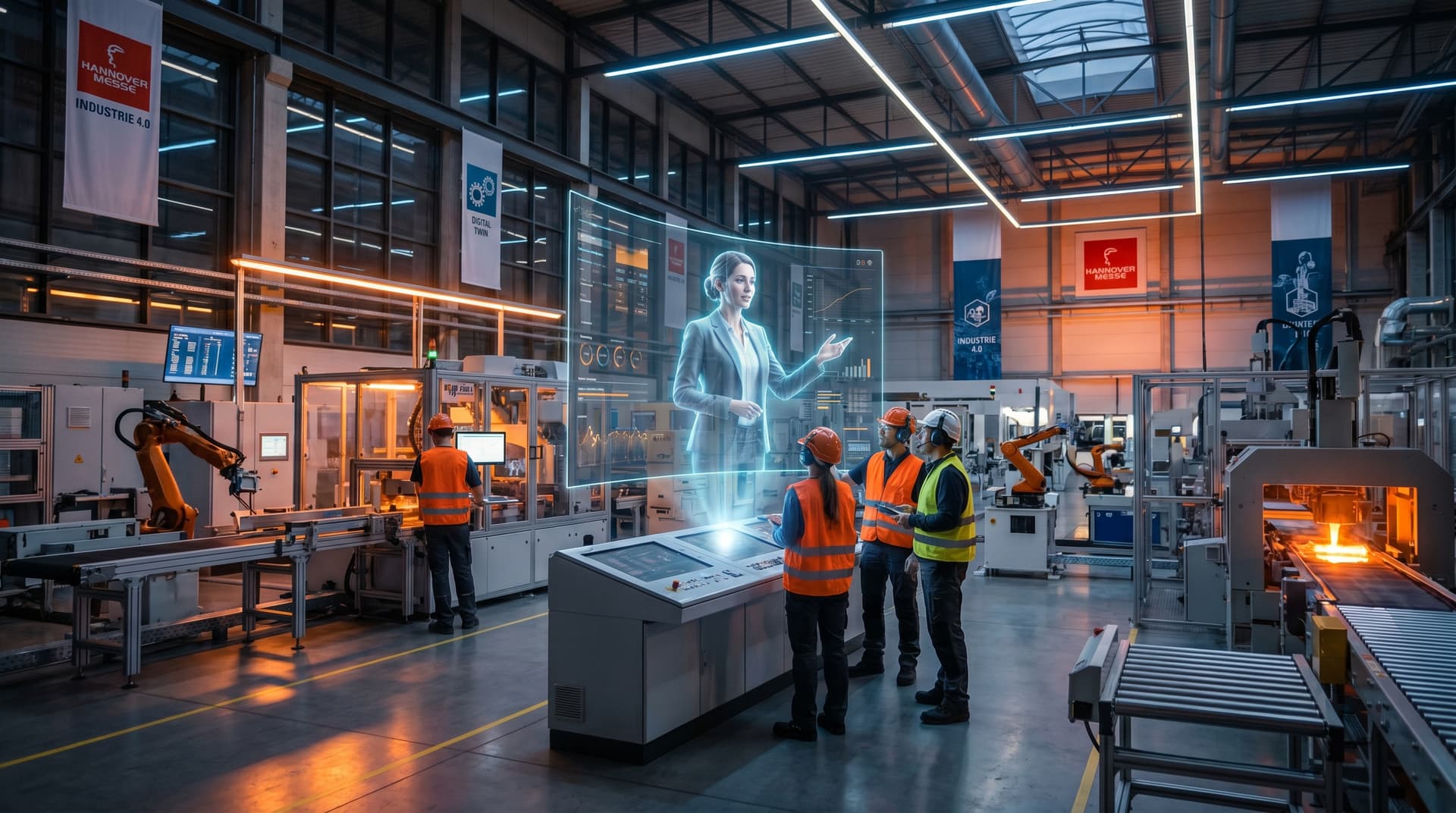

Hannover Messe 2026 — the world's largest industrial technology fair — closed on 24 April with a conclusion that its organisers, exhibitors, and the trade press coverage delivered without qualification: Industrial AI has crossed from strategic investment to competitive prerequisite. For European manufacturers, the message from Process and Control Today's summary of the fair was explicit: for firms still evaluating AI adoption, Hannover Messe 2026 marks the point at which delay becomes a strategic liability rather than a cautious posture [1]. Nine Fraunhofer institutes demonstrated AI avatars as factory floor digital teammates. Clinicians at DMEA Berlin saw AI analytics for heterogeneous patient data. A 64-partner consortium launched across 15 countries to address the energy problem that AI data centres impose on European grid infrastructure. Italy approved €211M for graphene optical interconnects targeting the bandwidth bottleneck inside AI accelerators. IQM deployed AI agents to calibrate quantum computers without specialist engineers.
The previous articles in this series tracked the construction of Europe's AI capability — the governance architecture (Article 1), the physical hardware layer (Article 2), the delivery gap between commitment and deployment (Article 3), and the sovereign compute infrastructure (Article 4). This article tracks the next phase: European industry actually using that capability, and the physical constraints — energy, bandwidth, operational complexity — that deployment at scale exposes.
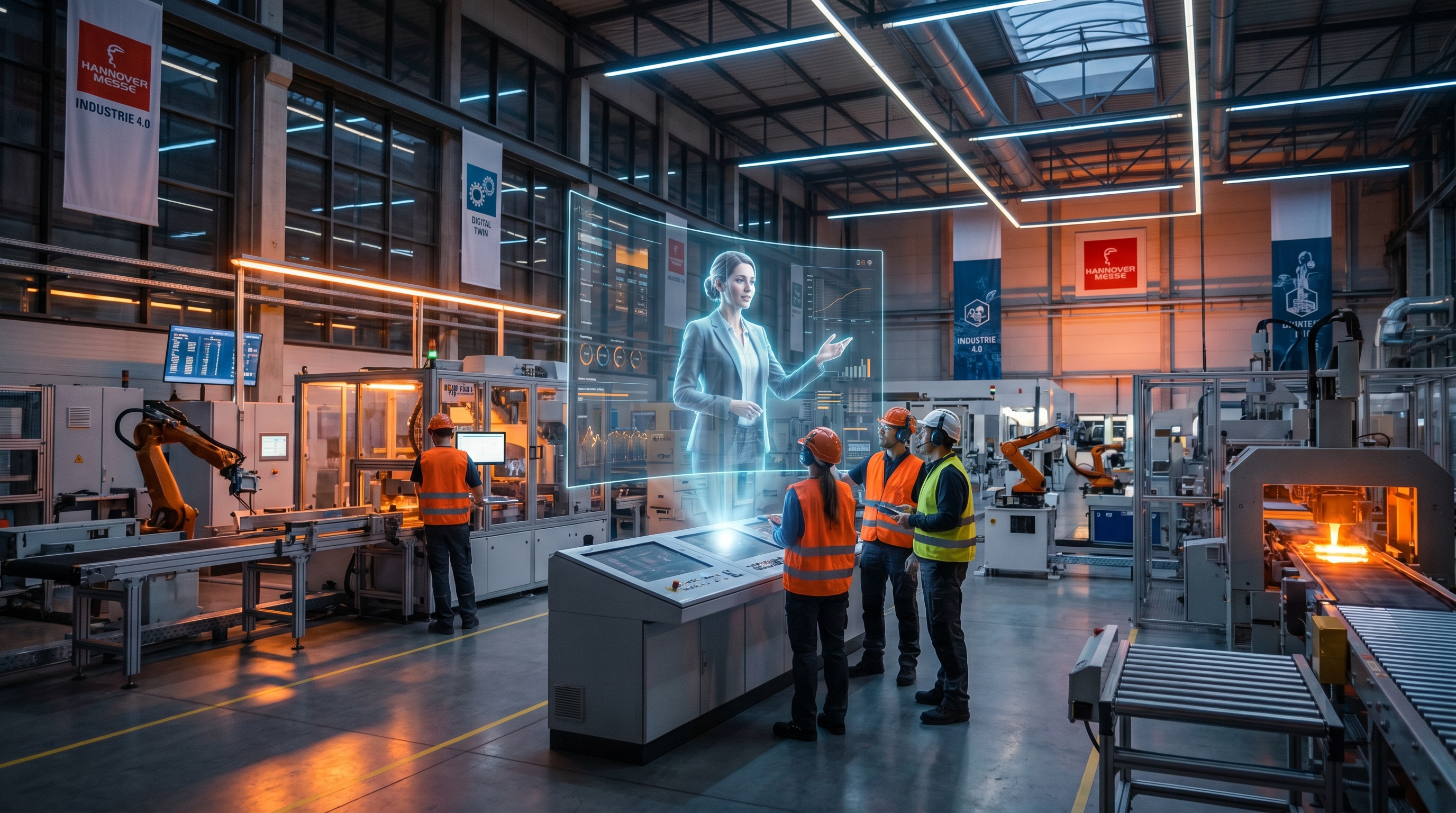
AI as industrial colleague: live demonstrations at Hannover Messe 2026 moved from prototype to operational deployment context, signalling the conversion phase for European manufacturing.
The Hannover Verdict
Hannover Messe is not a research conference. It is where European manufacturers make investment decisions. The fair's annual attendance runs into the hundreds of thousands; its exhibitors include the supply chain of European industrial production. When nine Fraunhofer institutes and the Research Fab Microelectronics Germany (FMD) closed their Hannover Messe 2026 presence with live demonstrations of photorealistic, voice-enabled AI avatars acting as industrial decision-making partners — not controlled laboratory demonstrations but operating factory-floor contexts — it represented a shift in the register of the Industrial AI conversation [2]. The FMD pilot-line access model, simultaneously presented, specifically addressed Mittelstand firms that need semiconductor R&D capacity without building it in-house — connecting the AI deployment question to the materials and fabrication question that is the subject of the next article in this series.
The significance of the Hannover verdict is not that AI capability is now available to European manufacturers — that has been true for several years. It is that the fair's institutional framing has shifted from "AI is an investment opportunity" to "AI adoption delay is a competitive cost." That shift in framing is itself a market signal: it changes the risk calculus for Mittelstand management teams that have been deferring AI investment on the grounds that the technology is still maturing. Process and Control Today's analysis framed the transition around the specific claim that, by 2030, Industrial AI — autonomous robotics, AI-driven manufacturing simulation, human-machine collaboration — will be the single most consequential competitive differentiator for European industry [1].
Four Deployment Domains
The industrial AI conversion story of April 2026 played out across four distinct deployment domains, each with different technical characteristics, different institutional actors, and different evidence of maturity.
Factory Floor: Digital Teammates
Nine Fraunhofer institutes demonstrated photorealistic, voice-enabled AI avatars at Hannover Messe 2026 — not as exhibit demonstrations but as live factory-floor decision-support tools, alongside bio-based plastics and sustainable energy storage [2]. The FMD pilot-line access model enables Mittelstand semiconductor R&D without in-house fabrication infrastructure. The deployment frame is operational: AI as an industrial colleague, not a research tool.
Clinical: AI Analytics at the Point of Care
At DMEA 2026 in Berlin (April 21–23), Fraunhofer IGD demonstrated RenalViz — interactive AI and visual analytics tools for heterogeneous patient data in nephrology [3]. The technology targets both administrative burden reduction and data-driven clinical research. Fraunhofer's positioning explicitly offers this through transfer partnerships to mid-market healthcare and medtech firms — the clinical-sector equivalent of the Mittelstand AI adoption story unfolding simultaneously at Hannover Messe.
Quantum Operations: AI Calibrating AI-Adjacent Hardware
IQM (Finnish-German) unveiled AI-based agentic calibration on April 14, using NVIDIA Ising models to automate the tuning of quantum processors [9]. The approach eliminates the need for resident quantum calibration specialists and makes quantum computers operationally viable for enterprise AI factories. This is the frontier of Industrial AI deployment: AI agents managing the operation of quantum-adjacent hardware in industrial contexts, blurring the boundary between classical and quantum operational domains.
Data-Centre Infrastructure: Photonics for AI Scale
Two April announcements directly addressed the physical constraints that AI data-centre deployment imposes. HiCONNECTS launched as a 64-partner, 15-country initiative to build photonics-based computing and networking systems that reduce AI data-centre electricity consumption [4]. CamGraPhIC received €211M Italian state approval for graphene optical interconnects targeting the data-movement bottleneck inside AI accelerators [5]. Both address the infrastructure layer that makes AI deployment at scale physically sustainable.
The AI Data-Centre Infrastructure Problem
Industrial AI conversion is not purely a software and organisational challenge. It is also a physical infrastructure challenge: AI workloads at scale run into energy consumption, bandwidth, and interconnect latency constraints that determine whether AI deployment is economically viable at the data volumes that industrial applications generate. Three April announcements address these constraints from different angles, and together they constitute the infrastructure layer without which the adoption signals from Hannover Messe remain aspirational.
HiCONNECTS represents the broadest response: 64 partners across 15 countries — semiconductor companies, equipment makers, universities, and research institutes — coordinating to build photonics-based computing and networking systems that slash the electricity footprint of AI data centres, mobile networks, and cloud infrastructure [4]. Data Centre News framed it as Europe's intent to "own the optical interconnect layer as AI energy costs escalate." The strategic motivation is clear: if European manufacturers are to deploy AI at industrial scale, the energy cost of that deployment must be manageable within European grid infrastructure and European sustainability commitments. Photonic interconnects — which use light rather than electrons to move data within and between systems — offer an order-of-magnitude improvement in energy per bit transported. The HiCONNECTS consortium is Europe's institutional response to the fact that conventional copper and silicon interconnects cannot scale to the data rates that AI workloads require at acceptable power budgets.
CamGraPhIC (a spinout of Cambridge Graphene Centre, based in Pisa) targets a more specific bottleneck: the data-movement constraint inside AI accelerators and HPC systems — the bandwidth wall between memory and compute that limits how fast AI chips can be fed with data. Italy's €211M state approval funds a pilot manufacturing facility near Milan for graphene-based optical interconnects. EU Startups described the deal as dwarfing comparable recent European photonics rounds combined (~€170M total across all comparable rounds) and noted over 150 specialised jobs planned at the manufacturing facility [5].
EuroHPC JU's €30M, five-year contract with Bull to expand Sweden's Mimer AI Factory at Linköping, co-funded by the Digital Europe Programme and the Swedish Research Council, adds compute supply to the infrastructure picture [6]. The Mimer expansion targets healthcare, materials science, and autonomous systems R&D — the industrial application domains where European organisations are most actively seeking AI compute access. Its significance is complementary to HiCONNECTS and CamGraPhIC: where the photonics initiatives reduce the energy cost of AI at the interconnect layer, Mimer increases the available compute capacity at the training and inference layer.
Capital directed at AI infrastructure (interconnects, compute) and adoption enablement (SME guarantees, pre-accelerator). Sources: [4], [5], [6], [7], [8].
Capital Mobilising at the Adoption Layer
The Hannover Messe announcements included a direct capital mobilisation signal from the EIB Group, which confirmed over €2.4B in new financing at the fair, with a €100M InvestEU guarantee specifically enabling German SMEs to invest in robotics, automation, and AI [7]. The distinction between this instrument and the research funding discussed in prior articles is significant: the InvestEU guarantee is designed to reduce the risk of SME borrowing for operational AI investment, not to fund R&D. It targets the deployment layer — companies that have identified AI applications they want to implement and need affordable debt financing to do so — rather than the innovation layer that Horizon Europe and the EIC address.
The EIC Pre-Accelerator cohort of April 2026 completes the capital picture from the other end of the pipeline. The 70 early-stage deep-tech companies selected from 22 EU and associated countries, receiving approximately €32.5M with 24% of projects women-led, represent the entry point into the innovation-to-deployment funnel [8]. EIC's description of the cohort as "a direct pipeline into the EIC Accelerator" and "the EU's most accessible on-ramp for deep-tech SMEs" positions it explicitly as the early-stage layer of the same capital stack the EIB is addressing at the deployment end.
360 Capital's €85M fund closing (French-Italian VC, targeting semiconductors, cybersecurity, robotics, and energy transition, up to 25 startups planned) adds the private-sector venture layer to this picture [10]. The co-occurrence of the EIB SME guarantee (deployment capital), the EIC Pre-Accelerator (early-stage innovation pipeline), and the 360 Capital fund (venture-stage scale-up) in a single fortnight is not coordinated — these are independent capital instruments operated by different institutions — but their simultaneous activation reflects the maturation of the industrial AI ecosystem from a research-and-development phase to a deployment-and-scale phase.
"For European manufacturers still evaluating AI adoption, Hannover Messe 2026 marks the point at which delay becomes a strategic liability rather than a cautious posture."
Fraunhofer at IFAT: Industrial AI Meets Circular Economy
One signal that did not originate at Hannover Messe is worth noting in the same breath. In advance of IFAT Munich (May 4–8), eight Fraunhofer institutes announced their joint showcase of circular economy technologies: phosphorus and nitrogen recovery from wastewater, rare-metal extraction from e-waste, and wind-turbine composite blade recycling under the RECREATE EU project [11]. Fraunhofer described these as "near-market technologies ready for licensing and pilot partnerships" for industrial companies managing waste streams and seeking raw-material security. The AI connection is operational rather than structural: the recovery and sorting processes involved in rare-metal extraction from e-waste and composite blade recycling are domains where AI-assisted sensing and classification are already in industrial use. The IFAT showcase is a downstream signal of the same industrial AI conversion that Hannover Messe addressed from the production side.
Tensions and Tests
The Hannover verdict and the April capital signals are real. The InvestEU guarantee has disbursement structures and reporting requirements; the EIC Pre-Accelerator cohort is selected. But three structural tensions prevent this from being an uncomplicated conversion narrative.
The SME adoption gap is demand-side, not supply-side. The EIB's €100M guarantee reduces the cost of borrowing for AI investment; it does not resolve the internal AI talent shortfall, unclear ROI calculations, and regulatory uncertainty under the AI Act that are the primary barriers to Mittelstand adoption. Instruments that address the supply side of capital (guarantees, grants) are necessary but not sufficient when the constraint is capability and governance, not financing access.
HiCONNECTS is a consortium, not a product. Coordinating 64 partners across 15 countries is a significant organisational undertaking. Photonic interconnect R&D has a long history of laboratory results that have not reached data-centre commercial deployment at the unit economics required. The strategic intent is unambiguous; the timeline from 64-partner consortium to deployed optical interconnects in European AI data centres has not been published.
CamGraPhIC is pre-production. The €211M Italian state approval funds a pilot manufacturing facility, not volume production. The graphene optical interconnect market is nascent. Whether graphene-based interconnects reach the unit economics required for data-centre deployment within the 2027–2028 window that AI infrastructure buildout demands remains unresolved at this stage of the technology's development.
Looking Ahead
- IFAT Munich, 4–8 May 2026: Eight Fraunhofer institutes will showcase near-market circular economy and industrial AI-assisted recovery technologies at Europe's largest environmental technology fair [11].
- EIC Pre-Accelerator → EIC Accelerator pipeline: The 70-firm cohort is positioned as "a direct pipeline into the EIC Accelerator." The proportion of the cohort that advances to Accelerator applications by September 2026 will be an early signal of the programme's conversion rate from pre-seed to growth-stage [8].
- HiCONNECTS first milestone publications: A 64-partner photonics consortium at this scale is expected to publish technology roadmaps and initial demonstrator specifications in 2026. These will establish the credibility timeline for the photonic interconnect promise [4].
- EuroHPC Mimer expansion capacity: The €30M, five-year Mimer AI Factory expansion gives European researchers and SMEs in healthcare, materials science, and autonomous systems access to expanded AI compute from 2026. Utilisation rates will determine whether the investment addresses a real bottleneck or adds to underutilised European HPC infrastructure [6].
References
[1] Process and Control Today, "Hannover Messe 2026: Industrial AI as competitive game-changer," Process and Control Today, Apr. 2026. [Online]. Available: https://www.pandct.com/news/hannover-messe-2026-industrial-ai-as-competitive-game-changer
[2] Fraunhofer-Gesellschaft, "Technology transfer and high-tech solutions: Fraunhofer at Hannover Messe 2026," Apr. 2026. [Online]. Available: https://www.fraunhofer.de/en/press/research-news/2026/april-2026/technology-transfer-and-high-tech-solutions-fraunhofer-at-hannover-messe-2026.html
[3] Fraunhofer-Gesellschaft, "Fraunhofer at DMEA 2026," Apr. 2026. [Online]. Available: https://www.fraunhofer.de/en/press/research-news/2026/april-2026/Fraunhofer-at-dmea-2026.html
[4] Data Centre News, "Europe launches HiCONNECTS to cut AI data centre power," Apr. 23, 2026. [Online]. Available: https://datacentrenews.uk/story/europe-launches-hiconnects-to-cut-ai-data-centre-power
[5] EU Startups, "CamGraPhIC lands EUR 211 million to tackle AI's data bottleneck in one of Italy's largest deeptech funding deals," EU Startups, Apr. 2026. [Online]. Available: https://www.eu-startups.com/2026/04/camgraphic-lands-e211-million-to-tackle-ais-data-bottleneck-in-one-of-italys-largest-deeptech-funding-deals/
[6] Innovation News Network, "EuroHPC and Bull collaborate to deploy AI supercomputer at Mimer AIF," Innovation News Network, Apr. 23, 2026. [Online]. Available: https://www.innovationnewsnetwork.com/eurohpc-and-bull-collab-to-deploy-ai-supercomputer-at-mimer-aif/68893/
[7] European Investment Bank, "EIB Group confirms support for EUR 2.4 billion energy resilience and deep-tech innovation at Hannover Messe," EIB Press, Apr. 23, 2026. [Online]. Available: https://www.eib.org/en/press/all/2026-140-eib-group-confirms-support-for-eur-2-4-billion-energy-resilience-and-deep-tech-innovation-at-hannover-messe
[8] European Innovation Council, "EIC Pre-Accelerator supports 70 early-stage deep-tech companies from countries with lower innovation capacity," Apr. 23, 2026. [Online]. Available: https://eic.ec.europa.eu/news/eic-pre-accelerator-supports-70-early-stage-deep-tech-companies-countries-lower-innovation-2026-04-23_en
[9] The Quantum Insider, "IQM AI-based calibration for scalable quantum systems," Apr. 14, 2026. [Online]. Available: https://thequantuminsider.com/2026/04/14/iqm-ai-based-calibration-scalable-quantum-systems/
[10] Sesamers, "Fundraising of the week 16: European startups — quantum, AI, deeptech," Sesamers, Apr. 2026. [Online]. Available: https://blog.sesamers.com/fundraising-news/fundraising-of-the-week-16-european-startups-quantum-ai-deeptech/
[11] Fraunhofer-Gesellschaft, "Fraunhofer at IFAT Munich 2026," Apr. 2026. [Online]. Available: https://www.fraunhofer.de/en/press/research-news/2026/april-2026/fraunhofer-at-ifat-munich-2026.html
Pulse News Team
ResearchArk